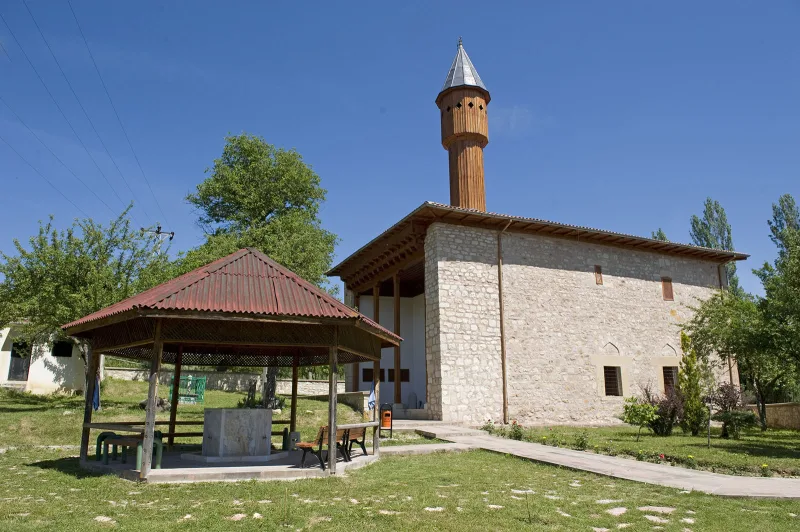
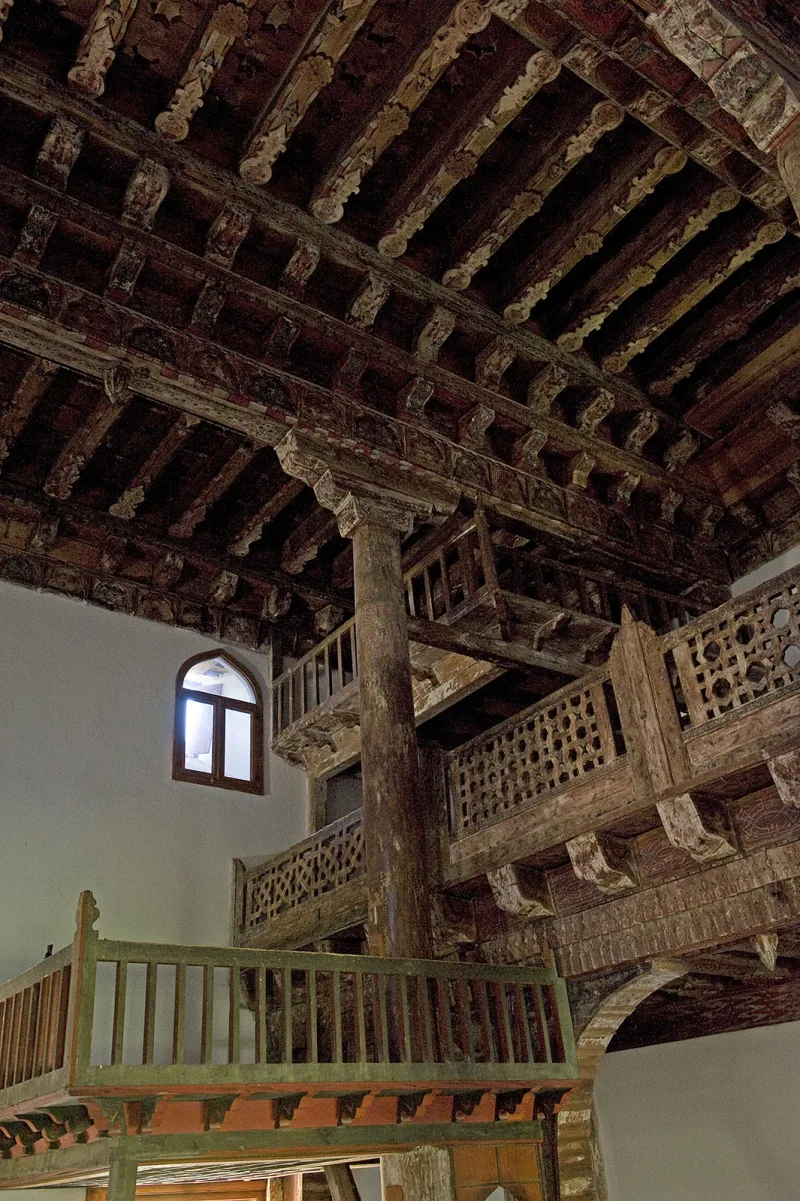
Mahmut Bey Mosque in Kasaba—a 14th-century wooden mosque

Mahmut Bey Mosque: A Wooden Marvel of Northern Anatolia

In the quiet village of Kasaba, 17 kilometers northwest of Kastamonu, nestled among the Black Sea hills, lies one of Turkey’s most striking medieval structures—Mahmut Bey Camii. It is a wooden mosque from the late 14th century, built without a single iron nail, with a ceiling painted with mineral pigments seven hundred years ago. From the outside, it is a modest rural mosque under a roof; inside, a forest of carved columns, a multi-tiered ceiling, and colorful ornaments make it a world-class gem of Anatolian wooden architecture.

History of the Mosque

Mahmut Bey Camii was built in 1366 (768 AH) during the reign of the emirs of the Candaroğulları (Candarids) dynasty—one of the beyliks that emerged after the collapse of the Seljuk Sultanate of Rum and controlled Kastamonu and the Black Sea coast. The patron who gave the mosque its name was Mahmut Bey, a local nobleman from the Candaroğlu family. This is indicated by a carved inscription above the entrance portal, executed with great skill on a piece of walnut wood.

The mosque belongs to a rare type of Anatolian wooden hypostyle mosques with a flat painted ceiling. Such structures have survived in only a few places—in Beyşehir (Eşrefoğlu Camii), Sivrihisar, Afyon, and Ankara (Aslanhane Camii). All of them represent one of the pinnacles of 13th–14th-century Anatolian wooden architecture. Mahmut Bey stands out among them for the quality of preservation of its paintings and the authenticity of its construction.

Over the course of six and a half centuries, the mosque has been repaired several times but has never undergone a radical reconstruction. Modern restorations carried out in the 1950s and 2010s were primarily aimed at reinforcing the roof and preserving the murals. Mahmut Bey is included on UNESCO’s Tentative List as part of the nomination “Wooden-Roofed and Column-Supported Mosques in Anatolia” (2018).

Architecture and What to See

Exterior and Portal

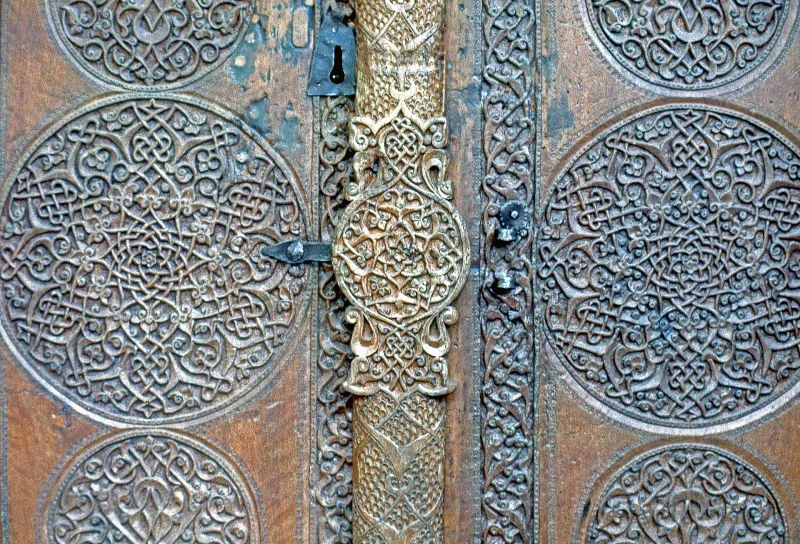
From the outside, the mosque looks distinctly modest: massive walls of hewn stone, a hipped tiled roof, and small window openings. The main entrance on the north wall is adorned with an intricately carved wooden portal and a heavy double door made of walnut wood, featuring carved arabesques, lotus motifs, and geometric patterns. The stone minaret, relatively short, is situated on the northwest side.

Columns and Ceiling

The main reason to visit Kasaba is the interior. The prayer hall is hypostyle: the square plan is divided by four massive wooden columns into nine sections. The columns rest on stone bases and support a beam ceiling painted in three tiers. Above the central section is the most intricate ceiling, imitating a dome: concentric octagons converge toward a central rosette. The entire structure is assembled without iron nails, using only wooden dowels and mortise-and-tenon joints.

Paintings

The ceiling is covered with original 14th-century paintings: red, green, blue, and ochre tones, executed in mineral pigments, form intricate geometric and floral patterns. Motifs of lotuses, six-pointed stars, interlacing patterns, and rosettes predominate. Arabic inscriptions have been preserved on some of the beams. This is one of the largest and best-preserved collections of medieval Islamic paintings on wood in Turkey.

Mihrab and Minbar

The mosque’s mihrab, unlike typical stone ones, is made of wood and painted in the same color palette as the ceiling. The minbar is also wooden, featuring carved panels from the 14th century: the composition is inspired by the Seljuk tradition of Konya but possesses its own local characteristics. This is a rare example of a preserved medieval wooden minbar in situ.

Women’s gallery and mahfil

In the northern part of the hall, above the entrance, there is a wooden gallery for women (kadınlar mahfili) supported by carved consoles. It offers the best view of the ceiling and the central section.

Interesting facts

  • Mahmut Bey Camii was built without a single iron nail—all joints are made using wooden dowels, mortise-and-tenon joints, and tenons.
  • The ceiling paintings are original 14th-century works; restorers limited themselves to consolidation, without repainting the lost sections.
  • The mosque is included on UNESCO’s tentative list as part of the transnational nomination “Anatolian Wooden Hypostyle Mosques” along with Eşrefoğlu Camii in Beyşehir.
  • The carved door of the main entrance is a masterpiece in its own right; the walnut was aged for years before carving, and the work itself was done by local Candaroğulları craftsmen.
  • The village of Kasaba has been designated a “cultural village” thanks to the mosque; local authorities restrict new construction in its vicinity.

How to get there

The mosque is located in the village of Kasaba, Daday district, Kastamonu province. It is about 17 km northwest of the city of Kastamonu. By car, the drive takes 25–30 minutes: take the Kastamonu–Daday highway and follow the signs for Kasaba Köyü / Mahmut Bey Camii.

By public transport: dolmuşes run from Kastamonu to Daday (about 40 min), but there is no direct transport to Kasaba—from there, you’ll have to take a taxi (about 7 km) or ask local residents for a ride. The most convenient option is to rent a car or hire a taxi for the day from Kastamonu (negotiable round-trip price including waiting time).

The nearest airport is Kastamonu (KFS), but flights there are irregular. It’s more convenient to fly to Ankara (ESB), then travel 220 km along Highway D765 to Kastamonu—about 3 hours by car or bus.

Tips for travelers

Mahmut Bey Camii is an active mosque, and visitors must follow general rules: remove your shoes at the entrance (wooden shelves are provided), women must cover their heads with a scarf, and clothing must cover the shoulders and knees. It is cool inside even in summer—the wooden walls and stone foundation keep the interior cool.

The best time to visit is during the summer and early fall months (May–October): in winter, roads can be difficult to navigate due to snow. The hours just before sunrise and just before sunset are best for photography, when the slanting light from the small windows highlights the relief of the murals. Avoid Friday prayers and prayer times.

Entrance to the mosque is free. A local caretaker is often on duty, ready to share details about the murals and the building’s history—a small tip would be appreciated. Flash photography is prohibited inside: bright light damages the pigments of the 14th-century murals.

Combine your visit with a tour of other attractions in Kastamonu Province: the Kastamonu Kalesi citadel, Efendikhan, and Ilgaz National Park. In the village of Kasaba, there are several small tea houses where you can relax and sample local cheese and bread.
Your comfort is important to us, click on the desired marker to create a route.
Meeting for minutes before
Yesterday. 17:48
Frequently asked questions — Mahmut Bey Mosque in Kasaba—a 14th-century wooden mosque Answers to frequently asked questions about Mahmut Bey Mosque in Kasaba—a 14th-century wooden mosque. Information about the service's operation, capabilities, and use.
Mahmut Bey Mosque is one of the few surviving Anatolian wooden hypostyle mosques featuring a flat, painted ceiling. Its uniqueness lies in the combination of authentic 14th-century murals, a structure built without a single iron nail, and a magnificently preserved wooden mihrab and minbar still in their original locations. The closest analogues are the Eşrefoğlu Mosque in Beyşehir, the Aslanhane Mosque in Ankara, and the mosques in Sivrihisar and Afyon, but in terms of the quality of preservation of its paintings, the Mahmut Bey Mosque stands out among them all.
The mosque was built in 1366 during the reign of the emirs of the Candaroğulları dynasty (Candarids/Zhandarids)—one of the Anatolian beyliks that emerged following the collapse of the Seljuk Sultanate of Rum. They controlled Kastamonu and the Black Sea coast. The patron of the construction was Mahmut Bey, a prominent member of the Candaroğlu family. His name and the date of construction are recorded in a carved inscription above the entrance portal on a walnut wood panel.
Yes, this is a proven fact. All load-bearing joints in the structure—columns, beams, and ceiling panels—are constructed exclusively using wooden dowels, mortise-and-tenon joints, and tenons. This is a traditional technique of 13th–14th-century Anatolian timber architecture, which required the highest level of carpentry skill and allowed the structure to remain intact without metal fasteners for centuries.
The ceiling is covered with original 14th-century paintings executed in mineral pigments—red, green, blue, and ochre. The patterns include lotus motifs, six-pointed stars, interlacing designs, and rosettes, and above the central compartment, the painted ceiling mimics a dome with concentric octagons. Restorers deliberately limited their work to consolidating the pigments without restoring lost sections, so what you see before you is an authentic 700-year-old painting, one of the largest collections of medieval Islamic paintings on wood in Turkey.
Not yet, but the mosque has been on UNESCO’s Tentative List since 2018—as part of the transnational nomination “Wooden-Roofed and Column-Supported Mosques in Anatolia.” The Eşrefoğlu Camii in Beyşehir is also included in this nomination. A final decision on inclusion in the World Heritage List has not yet been made, but the tentative status itself attests to the site’s exceptional value at the international level.
Admission to Mahmut Bey Camii is free. The mosque remains an active place of worship, not a museum. A local caretaker is often on duty there and can tell you about the building’s history and the details of the murals—a small voluntary donation on your part would be appropriate and gratefully accepted.
Photography is permitted, but the use of flash is strictly prohibited: intense light damages the pigments in the original 14th-century frescoes. The best photos are taken in the morning or just before sunset, when the slanting natural light streaming through the small windows highlights the relief of the carvings and the texture of the frescoes. A long exposure mode or a fast lens is the best choice for shooting in the soft, diffused light of the interior.
Mahmut Bey Mosque is an active place of worship, so standard rules apply: shoes must be removed at the entrance (there are wooden shelves by the threshold), women must cover their heads with a scarf, and all visitors’ clothing must cover their shoulders and knees. It stays cool inside even in summer—the wooden walls and stone foundation help keep the air cool, so a light extra layer of clothing is a good idea.
Yes, Kastamonu Province is rich in attractions. In the city of Kastamonu itself, you’ll find the medieval Kastamonu Kalesi citadel, offering panoramic views of the city, and the historic Efendihan. In the surrounding area lies Ilgaz National Park, featuring picturesque Black Sea forests and mountain trails. Here’s a convenient itinerary: in the morning, visit Mahmut Bey Camii in Kasaba; in the afternoon, explore Kastamonu Kalesi; and in the evening, take a stroll through the historic center of Kastamonu.
The recommended visit time is about 90 minutes. This is enough time to take a close look at the ceiling murals, wooden columns, mihrab, minbar, and women’s gallery, chat with the curator, and take photos. If you’re interested in architectural history or Islamic art, plan on spending two hours. There’s no need to rush: the details of the carvings and paintings reveal themselves gradually as your eyes adjust to the subdued lighting inside.
User manual — Mahmut Bey Mosque in Kasaba—a 14th-century wooden mosque Mahmut Bey Mosque in Kasaba—a 14th-century wooden mosque User Guide with a description of the main functions, features, and principles of use.
The best time to visit is from May through October. In spring and early fall, the weather is mild, and the roads leading to the village of Kasaba are in good condition. In winter, snowfall is possible, making the mountain roads in the Daday area difficult to navigate. Plan your visit for the morning hours or just before sunset: the slanting light highlights the relief of the murals and provides the best conditions for photography. Avoid Friday prayers and prayer times—the mosque is closed to tourists during these hours.
The nearest airport is Kastamonu (KFS), but flights there are infrequent. The most convenient option is to fly to Ankara (ESB) and then drive about 220 km along Highway D765 to Kastamonu—this takes approximately 3 hours by car or bus. Several companies operate regular intercity buses from Ankara to Kastamonu. If you’re traveling from Istanbul—the distance is about 430 km, and the drive takes 5–6 hours—or you can take a night bus.
The distance from Kastamonu to the village of Kasaba is about 17 km to the northwest; the drive takes 25–30 minutes. Follow the Kastamonu–Daday highway and look for signs for “Kasaba Köyü” and “Mahmut Bey Camii.” Renting a car is the most convenient option. If you don’t have a car: dolmuşes run from Kastamonu to Daday (about 40 minutes), but there is no direct transportation to Kasaba—from Daday, you’ll need to take a taxi for about 7 km or arrange a ride with locals. An alternative is to hire a taxi from Kastamonu for the entire day, including waiting time.
Please remove your shoes before entering and place them on the wooden shelves by the entrance. Make sure your clothing covers your shoulders and knees—this is a requirement for all visitors. Women must cover their heads: bring a scarf with you or use one provided by the attendant. Turn off the flash on your camera or phone—this is essential for the preservation of the murals.
Start with a general overview: let your eyes adjust to the subdued lighting and take in the scale of the hypostyle hall with its four wooden columns. Then look up at the ceiling—examine it section by section, paying special attention to the central section with its dome-like design. Next, approach the mihrab and minbar: both are made of wood and painted in the same color scheme as the ceiling. Conclude your tour by looking up at the women’s gallery (kadınlar mahfili) above the entrance—it offers the best view of the central section.
A local caretaker is often on duty at the site and is very knowledgeable about the mosque’s history. He can point out details of the murals that are easy to miss on your own: preserved Arabic inscriptions on the beams, traces of various restoration periods, and distinctive features of the portal’s carvings. Communication usually takes place in Turkish, so prepare some basic phrases in advance or use a translator. A small voluntary tip is accepted and appropriate.
After visiting Mahmut Bey Mosque, return to Kastamonu and explore Kastamonu Kalesi—a medieval citadel offering panoramic views of the city—and Efendihan in the historic center. If you have time, plan a visit to Ilgaz National Park, with its Black Sea forests and mountain trails. In the village of Kasaba, there are several small tea houses where you can conveniently stop after visiting the mosque: local cheese and fresh bread make for a nice way to end the morning part of the itinerary.